

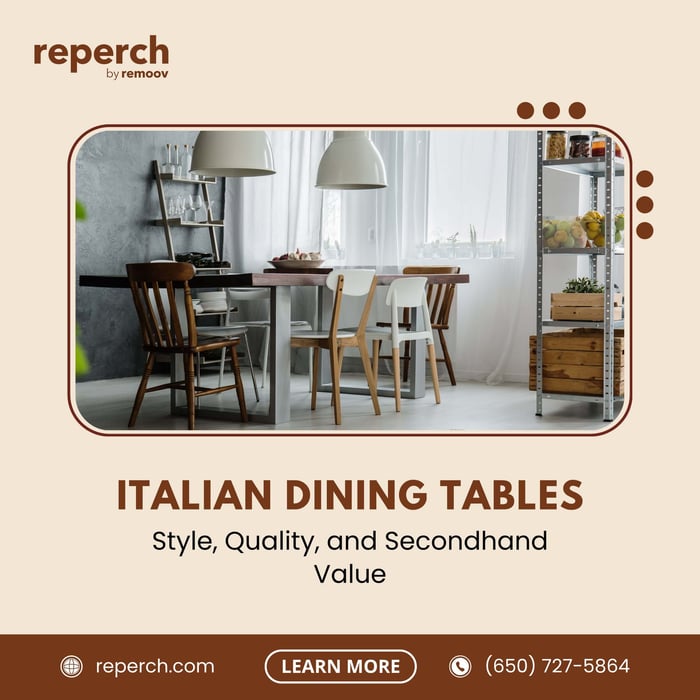
Italian dining tables can shape the entire character of dining rooms. Some designs feel warm and traditional, with rich wood grain and carefully finished details. Others are sleek and architectural, using marble, ceramic, glass, or sculptural metal bases to create a striking focal point.
What connects these different styles is an emphasis on proportion, materials, and craftsmanship. Italian furniture design is known for balancing visual elegance with practical use, which helps explain why many Italian dining tables remain desirable long after their original purchase.
For secondhand buyers, that lasting appeal can create valuable opportunities. A well-maintained Italian table may offer premium construction and distinctive design for considerably less than a comparable new piece. However, age, condition, authenticity, material quality, size, and brand recognition can all influence whether a table is genuinely worth buying.
This guide explains the major Italian dining table styles, the materials and construction details that indicate quality, and the factors that affect secondhand value.
Why Italian Dining Tables Stand Out
Italian dining furniture has developed through a long history of decorative arts, furniture making, architecture, and industrial design.
Earlier tables often featured carved wood, marble surfaces, decorative inlays, and formal proportions. These pieces were designed to communicate status while serving as the center of family and social gatherings.
During the twentieth century, Italian designers began combining traditional craft with modern materials and cleaner forms. Glass, steel, polished stone, lacquer, and engineered mechanisms became more common. The result was a design language that could feel luxurious without relying on heavy ornament.
Today, Italian dining tables range from classical and decorative to minimalist and highly sculptural. Even when the styles differ, the strongest examples usually share several qualities:
Balanced proportions
Carefully selected materials
Refined surface finishing
Stable construction
Thoughtful details
Practical everyday function
These qualities often help Italian tables retain visual relevance even as interior trends change.
Traditional Italian Dining Table Styles
Traditional Italian dining tables tend to emphasize warmth, craftsmanship, and decorative detail.
Carved Wood Tables
Solid wood tables may feature turned legs, carved aprons, shaped edges, or decorative feet. Walnut, cherry, oak, and mahogany are commonly associated with traditional European furniture because of their strength and attractive grain.
A well-made carved table can work in a formal dining room, a Mediterranean-inspired interior, or a home that combines antique and contemporary pieces.
When evaluating one secondhand, inspect the carved sections closely. Small losses, loose joints, insect damage, and previous repairs may be more difficult to see around detailed surfaces.
Trestle and Pedestal Tables
Trestle tables use a supporting base connected by a horizontal stretcher. This construction can create a substantial appearance while leaving more room along the sides for chairs.
Pedestal tables rely on one or more central supports instead of four corner legs. Round pedestal tables are particularly useful for conversation because guests can face one another more easily.
Traditional pedestal bases may include carved columns or decorative feet, while modern versions often use stone, metal, or geometric forms.
Inlaid and Decorative Surfaces
Some Italian tables include marquetry, veneer patterns, stone inlays, or contrasting wood borders.
These details can increase visual interest and collector appeal, but condition matters. Look for lifting veneer, missing inlay, cracks, discoloration, and poorly matched replacement sections.
Minor wear may be expected on an older piece, but the decoration should remain secure and structurally stable.
Contemporary Italian Dining Table Styles
Modern Italian dining tables often make a strong impression through shape, material contrast, and engineering.
Minimalist Tables
Minimalist designs typically use clean lines, thin profiles, and restrained details. A simple rectangular top may rest on angled metal legs, a concealed support, or a geometric base.
These tables can suit contemporary, modern, and transitional interiors because they do not compete heavily with surrounding furniture.
Minimal styling does not necessarily mean simple construction. The balance between the tabletop and base may require precise engineering, especially when the surface is glass, ceramic, or stone.
Sculptural Bases
Many contemporary Italian tables use the base as the main design feature.
Curved metal supports, crossed legs, asymmetrical frames, and architectural pedestals can make the table feel more like a functional sculpture. These designs are effective in rooms where the table is visible from several angles.
Before buying, confirm that the dramatic base does not interfere with chair placement. A visually impressive support may reduce legroom if it extends too far beneath the tabletop.
Extendable Tables
Italian extendable dining tables are popular because they combine a refined appearance with flexible seating.
Extension systems may include concealed leaves, butterfly mechanisms, sliding tops, or synchronized openings. The best mechanisms operate smoothly and keep the expanded table level.
When shopping through a curated secondhand marketplace such as Reperch, review photographs of both the closed and extended positions, confirm the complete dimensions, and ask whether every leaf and mechanical part is included.
A missing extension leaf can significantly reduce both usefulness and resale value.
Premium Materials Used in Italian Dining Tables
Material choice affects the table’s appearance, maintenance needs, weight, and secondhand value.
Marble
Marble is one of the most recognizable luxury dining table materials.
Each slab has unique veining and natural variation, so no two tables look exactly alike. White marble may create a bright, elegant appearance, while darker stone can feel more dramatic and formal.
Marble is durable, but it is porous and can stain or etch when exposed to acidic foods and liquids. Inspect a secondhand surface for:
Chips along the edges
Hairline cracks
Dull or etched areas
Dark stains
Repaired breaks
Uneven sealing
A small amount of patina may be acceptable, but structural cracks require careful evaluation. Stone tops are also extremely heavy, so professional delivery may be necessary.
Ceramic
Ceramic dining tables have become popular in modern Italian design because they combine a stone-like appearance with practical durability.
Quality ceramic surfaces are generally resistant to heat, scratches, stains, and moisture. They are easier to maintain than many natural stone tops and can imitate marble, concrete, or other finishes.
Check the surface under angled light for chips, deep scratches, impact marks, or separation from the supporting panel. Also inspect the edges, as damage may be more visible there than across the main surface.
Solid Wood and Veneer
Wood brings warmth and natural variation to a dining space.
Solid walnut, oak, cherry, and other hardwoods can last for decades when properly maintained. Veneer can also be high quality when applied over a stable core and finished carefully.
Secondhand buyers should not assume that veneer indicates poor construction. Many premium tables use veneer to create consistent grain patterns or reduce movement in large surfaces.
Inspect for water rings, sun fading, deep scratches, loose veneer, refinishing, and signs of dryness. Check whether the tabletop remains flat and whether the finish is consistent.
Glass
Glass tops create visual lightness and allow a sculptural base to remain visible.
Tempered glass is stronger and safer than ordinary glass, but it can still develop scratches, chips, or cloudy areas. Check every edge and corner carefully.
Replacement glass may be expensive, particularly when the top has an unusual shape, beveled edge, custom thickness, or mounting system.
Metal
Metal is commonly used for legs, frames, and decorative supports.
Steel, brass, aluminum, and iron may be polished, brushed, painted, or powder-coated. Look for corrosion, dents, flaking finishes, loose welds, and instability.
Natural patina may suit certain brass or bronze finishes, but heavy oxidation should be examined closely.
How to Identify Quality Construction
A high asking price or Italian label does not automatically guarantee quality. Inspect the table as a complete object.
Stability
Place light pressure on different corners and check for movement. The table should not rock, twist, or shift excessively.
Loose hardware may be easy to tighten, but movement caused by damaged joints, warped supports, or a cracked base may require professional repair.
Joinery
Traditional wood tables may use mortise-and-tenon, dovetail, dowel, or other fitted joints. Modern tables may rely on precision hardware, welded metal, or engineered connection systems.
Look beneath the tabletop and inspect how the base is attached. Uneven screws, improvised brackets, and visible repair plates may indicate previous structural problems.
Finishing
The finish should be even and appropriate for the material.
On wood, look for smooth transitions, consistent staining, and protected edges. On lacquered surfaces, inspect for bubbling, peeling, cracking, and deep chips. Metal finishes should appear uniform unless the design intentionally uses patina.
Extension Mechanisms
Open and close the table several times. The mechanism should move without grinding, sticking, or requiring excessive force.
Confirm that the leaves align with the main surface and that the table remains stable when extended.
What Determines Secondhand Value?
Italian dining table resale value depends on more than the original retail price.
Brand or Designer
Tables from recognized manufacturers and designers often attract stronger demand because buyers can research the model, materials, and original specifications.
A clear manufacturer label, model name, or purchase record can support value. Unmarked tables may still be high quality, but they are more difficult to verify.
Material
Premium marble, ceramic, solid wood, and well-finished metal can support higher resale prices.
However, material alone is not enough. A damaged marble table may be less desirable than a well-maintained wood table with a lower original price.
Condition
Structural stability is usually more important than minor cosmetic wear.
Scratches, small finish marks, and natural patina may be acceptable. Cracked stone, missing leaves, loose bases, broken mechanisms, or severe water damage can reduce value considerably.
Size and Shape
Rectangular tables usually appeal to a broad range of buyers, while round and oval tables can be ideal for smaller or more social dining spaces.
Very large tables may have high original values but a smaller resale audience because fewer homes can accommodate them.
Current Usability
Tables that work with modern lifestyles often retain demand. Extendable models, durable ceramic surfaces, and designs that can double as workspaces may appeal to a wider group of buyers.
How to Choose the Right Table for Your Room
Measure more than the tabletop.
Allow enough clearance for chairs to move and for people to walk comfortably around the table. Around 36 inches of open space on each side is a useful minimum, while larger rooms may allow more.
Consider the room shape:
Rectangular rooms often suit rectangular or oval tables
Square rooms can work well with round or square tables
Narrow spaces may benefit from slim rectangular designs
Open-plan rooms can accommodate sculptural or larger tables
Also measure doorways, hallways, staircases, and elevators. Stone and ceramic tables may require the top and base to be moved separately.
Questions to Ask Before Buying Secondhand
Ask the seller for the manufacturer, model, approximate age, dimensions, materials, and known repair history.
Confirm whether the table includes:
Extension leaves
Mounting hardware
Protective pads
Manufacturer labels
Assembly instructions
Original purchase records
Request photographs of the underside, base connections, corners, edges, and any damaged areas.
For heavy tables, clarify whether delivery includes disassembly, room placement, and reassembly.
Is a Secondhand Italian Dining Table Worth Buying?
A used Italian dining table can be an excellent purchase when the construction is strong, the materials are genuine, and the condition matches the price.
Secondhand buyers may gain access to better materials and more distinctive design than they would find in new furniture at the same budget.
The strongest purchases are not always the most famous or expensive models. A well-built table that fits the room, seats the right number of people, and suits daily life may provide greater long-term value than a prestigious piece that is difficult to maintain or use.
Final Thoughts
Italian dining tables combine style, craftsmanship, and everyday function in ways that can remain appealing for many years.
Traditional carved wood, polished marble, modern ceramic, glass, and sculptural metal each offer a different interpretation of Italian design. The right choice depends on the room, household needs, maintenance preferences, and budget.
Before purchasing secondhand, inspect the structure, materials, finish, extension mechanism, and available documentation. Calculate the complete cost of delivery and any necessary repairs rather than focusing only on the listing price.
A carefully selected Italian dining table can become more than a place to eat. It can serve as the visual center of the room and a durable setting for meals, work, conversation, and family gatherings.